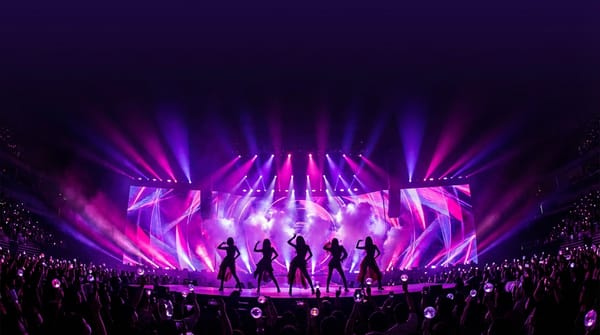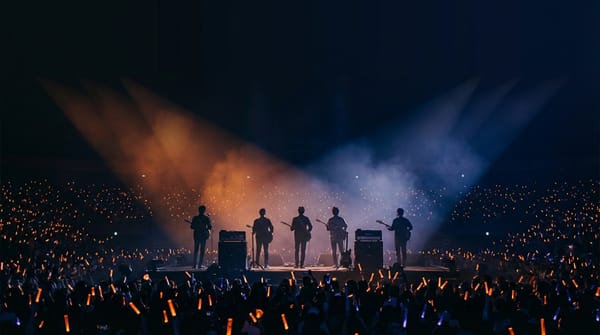
SEVENTEEN RIGHT HERE — The Peak of Self-Produced K-pop
2.26 million copies on day one. $120M in tour revenue. Here's why SEVENTEEN — led by WOOZI's 500+ songs and nine years of in-house production — sits at the peak of self-produced K-pop.
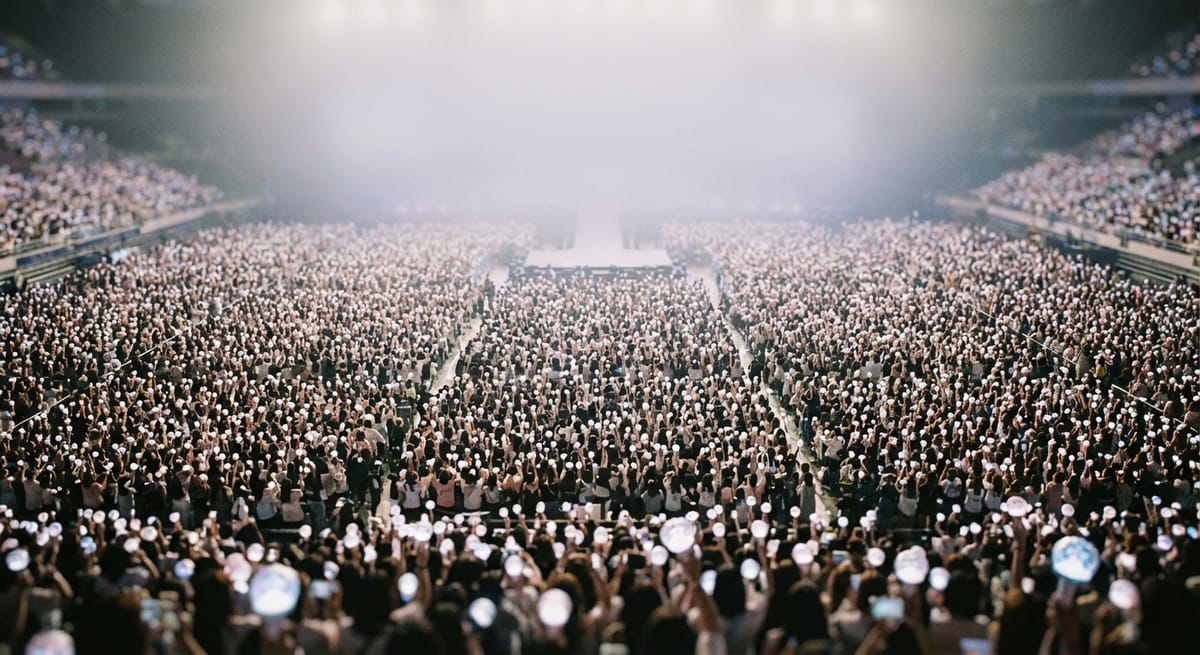
SEVENTEEN RIGHT HERE — The Peak of Self-Produced K-pop
2.26M copies on day one. $231M across two tours. What WOOZI and SEVENTEEN have proven.
The Best Album That Broke Records
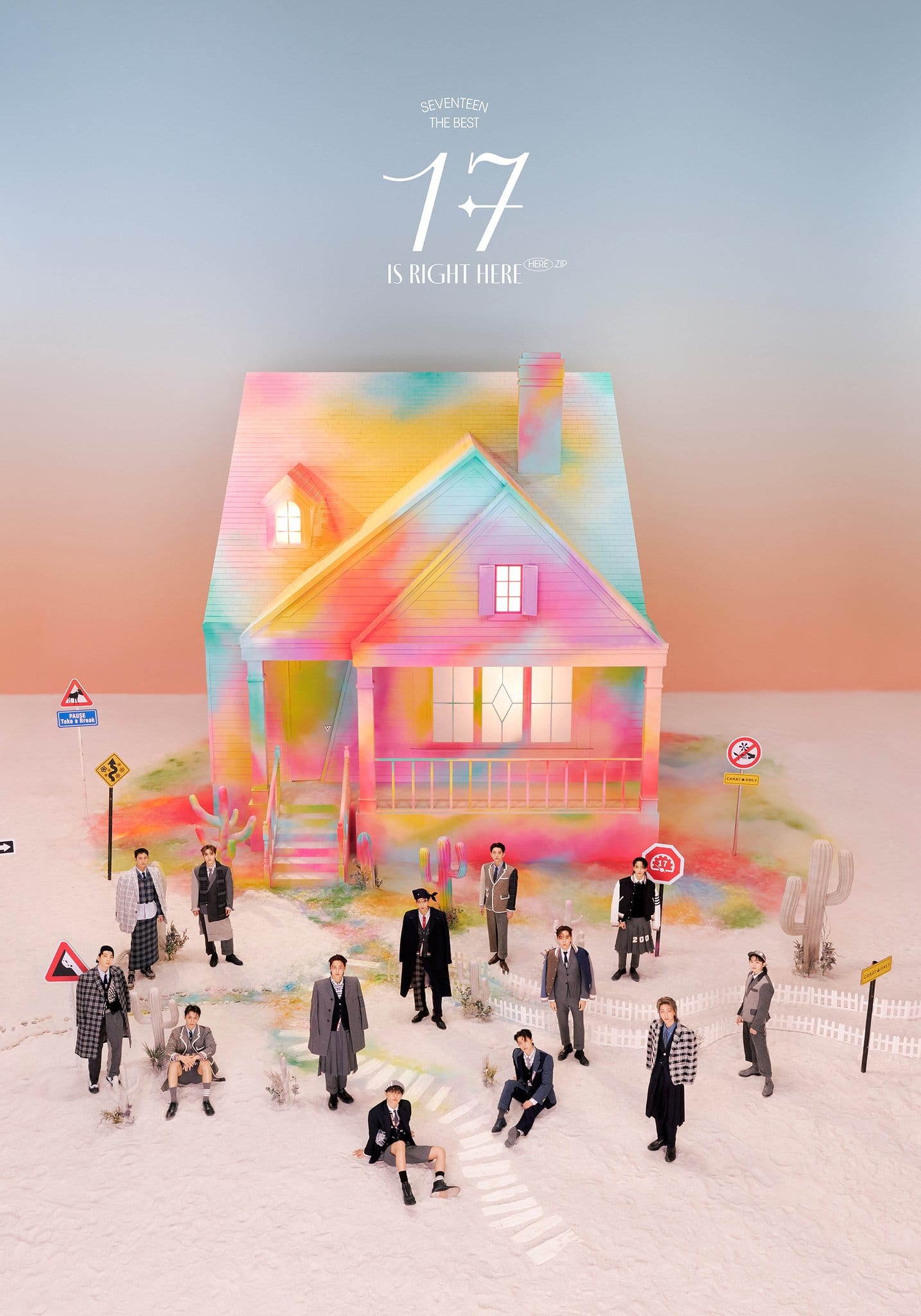
On April 29, 2024, SEVENTEEN's best album "17 IS RIGHT HERE" sold 2.26 million copies on its very first day. A best album. A compilation with only four new tracks, built mostly from existing hits.
Best albums are usually fan service. You repackage songs that are already out there, and sales tend to fall short of a proper studio record — that's just how it goes. But SEVENTEEN defied that logic entirely. They crossed 3 million copies within 10 days and set the highest first-week sales of any K-pop album in 2024.
Why? A bigger fandom? Better marketing? Or something else?
The answer is in the album credits. WOOZI's name appears all over them — composition, lyrics, production. SEVENTEEN didn't just claim the "self-produced idol" title as a marketing angle; they backed it up with tangible results. This piece breaks down exactly how they did it, in numbers.
17 IS RIGHT HERE — Nine Years of Proof
"17 IS RIGHT HERE" is SEVENTEEN's first Korean-language compilation album. It collects every Korean single they released from their 2015 debut track "Adore U" all the way through 2024 — nine years of music in one place. Korean versions of their Japanese singles and four brand-new songs round it out.
The lead single from the new material is "Maestro," written and composed by WOOZI and Bumzu, with members S.Coups, Wonwoo, Mingyu, Vernon, The 8, and Dino all receiving production credits. Another new track, "LOVE, MONEY, FAME," features DJ Khaled — and yes, WOOZI and Bumzu wrote that one too, with Vernon co-writing the lyrics.
 ▶
SEVENTEEN "MAESTRO" Official MV | Watch on YouTube
▶
SEVENTEEN "MAESTRO" Official MV | Watch on YouTube
What the Sales Numbers Actually Tell Us
The figures make the story clearer.
- Day one: 2.26 million copies (highest ever for a K-pop compilation album)
- Within 10 days: 3 million copies surpassed
- Highest first-week sales of 2024 across all K-pop releases
No compilation album in K-pop history had sold like this before. The usual benchmark for a best album is around 60–70% of a studio album's sales. SEVENTEEN didn't just hit that benchmark — they blew past it. The reason is pretty straightforward: fans weren't buying a "greatest hits package." They were buying nine years of music that SEVENTEEN themselves had made.
The album even includes a previously unreleased instrumental of "Adore U" — also composed by WOOZI. Back in 2015, a 19-year-old WOOZI had writing and composition credits on every track of their debut EP, "17 Carat." From that moment to now: nine years. It's rare for a single album release to serve as a document of an entire artistic career. SEVENTEEN made it happen.
WOOZI and the SEVENTEEN Self-Production System
Who Is WOOZI?
Born Lee Ji-hoon, known professionally as WOOZI — he's the leader of SEVENTEEN's vocal unit and the group's primary in-house producer. In 2019, he became a full member of KOMCA (Korea Music Copyright Association), with 157 officially registered works. Including unreleased material, the total reportedly exceeds 500 songs.
More than 80% of SEVENTEEN's discography has passed through WOOZI's hands. Hits like "Very Nice," "Pretty U," "Don't Wanna Cry," "Hot," and "Super" are all his work. He's also produced for other artists outside the group — NU'EST W, Ailee, and I.O.I among them.
That said, WOOZI doesn't work alone. His longtime collaborator Bumzu — a producer under PLEDIS Entertainment — has been his mentor and creative partner since before the group debuted. All five tracks on their debut album were co-produced by the two of them.
Why Every Member Having Credits Matters
The self-production at SEVENTEEN isn't just a WOOZI story. By 2017, every single member had writing credits to their name. All 13 of them.
- S.Coups, Mingyu, Vernon, Dino: contributed lyrics as far back as the debut album
- Hoshi: co-choreographed the majority of SEVENTEEN's title track performances; the performance unit regularly creates choreography for unit songs as well
- Vernon: co-wrote lyrics on "LOVE, MONEY, FAME"
- The 8: involved in solo tracks and Chinese-language versions
And it goes beyond music. Members have direct involvement in choreography, concept direction, and stage production. That's what genuine self-production looks like — not a name tacked onto someone else's work, but ownership from start to finish.
How SEVENTEEN Compares to Other Self-Produced Groups
SEVENTEEN isn't the only self-produced act in K-pop. BTS, (G)I-DLE, and Stray Kids are well-known for it too. But the systems are different.
| Group | Key Producer(s) | KOMCA Registered Works | Scope of Involvement |
|---|---|---|---|
| SEVENTEEN | WOOZI | 500+ | All 13 members — lyrics, composition, choreography |
| BTS | RM, SUGA, j-hope | RM 200+, SUGA 150+ | Rap line-led; full member participation |
| (G)I-DLE | Soyeon | 100+ | Soyeon-centric |
| Stray Kids | Bang Chan, Han | 200+ | 3RACHA-centric |
BTS is anchored by the rap line — RM, SUGA, and j-hope. RM alone has 200+ KOMCA registrations; SUGA has 150+. All members contribute, but the rap line carries the bulk of the creative weight. They also collaborate closely with Big Hit in-house producers like Pdogg, Slow Rabbit, and Supreme Boi.
(G)I-DLE runs almost entirely through Soyeon. She writes, composes, and produces the majority of their title tracks — with 100+ KOMCA registrations to her name. It's a model that bets heavily on one member's genius.
Stray Kids centers on 3RACHA — Bang Chan, Han, and Changbin. Bang Chan leads the group and holds 200+ registrations as its main producer. The setup is similar to SEVENTEEN's unit structure, but those three members do the overwhelming share of the work.
SEVENTEEN? WOOZI is at the center, but genuine participation spreads across all 13 members. The group splits into three units — vocal, hip-hop, and performance — and each creates within their domain. Everyone has a real role. That's the defining feature of the SEVENTEEN system.
The Numbers Behind the Success — What $120M in Tour Revenue Means
If self-production only delivered creative freedom, it would be a hobby. SEVENTEEN proved it translates into economic results.
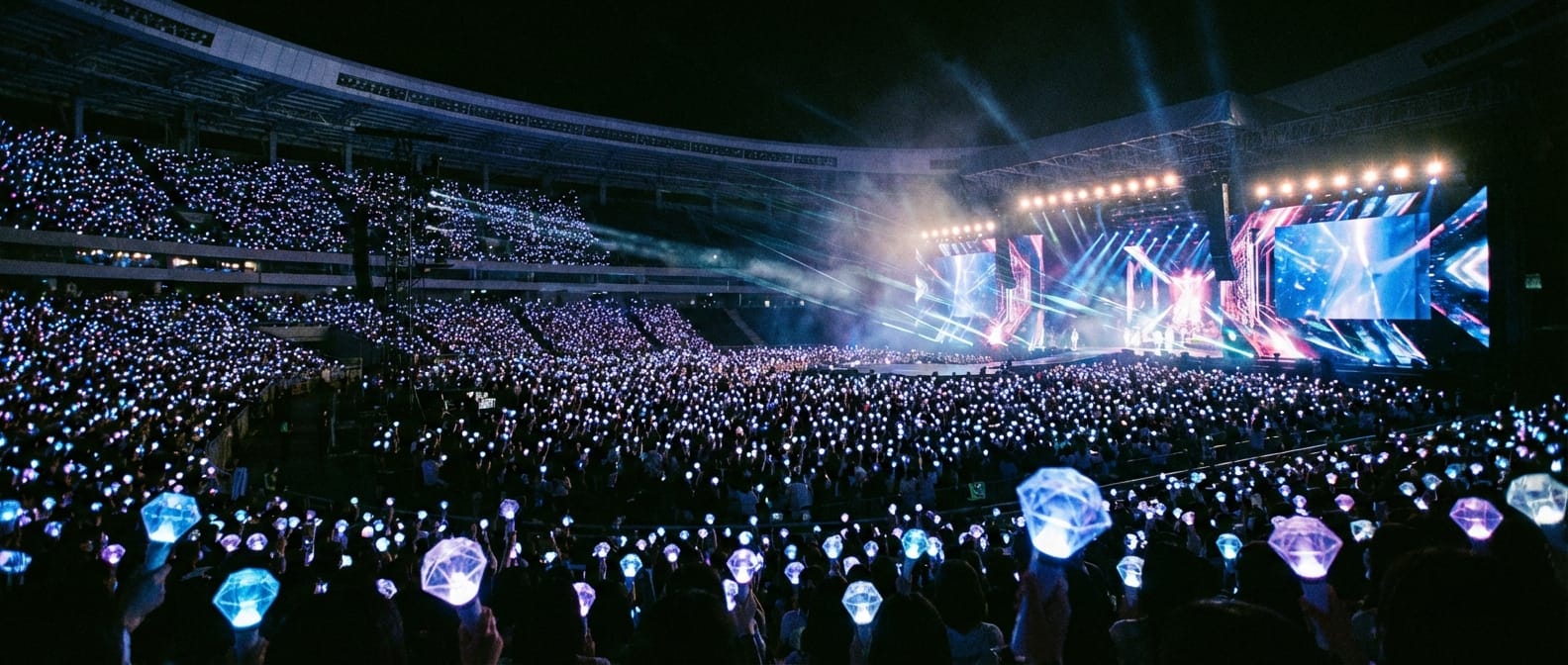
The RIGHT HERE World Tour
The RIGHT HERE World Tour launched on October 12, 2024 at Goyang Stadium in South Korea and wrapped up in Bangkok on February 16, 2025. Fourteen cities. Thirty shows. Over one million tickets sold — a first for any SEVENTEEN tour.
Total gross: $120 million. Total attendance: 844,751. The tour also marked SEVENTEEN's U.S. stadium debut at BMO Stadium in Los Angeles. Worth noting: Jeonghan was on mandatory military service (all Korean men are required to complete approximately 18–21 months of military service), and Jun was absent due to Chinese promotional commitments. Two of the 13 members were missing — and they still pulled this off.
The FOLLOW Tour and Combined Figures
The tour immediately preceding RIGHT HERE — the FOLLOW Tour in 2023 — was no small thing either. Total gross: $111.6 million. Tickets sold: 988,000. Shows: 28. It also produced SEVENTEEN's single highest-grossing concert on record: January 13, 2024 at the Philippine Sports Stadium, which brought in $5.8 million in one night. Over two nights: $11.6 million.
Put the two tours together:
| Tour | Total Gross | Attendance | Shows |
|---|---|---|---|
| FOLLOW | $111.6M | ~988,000 | 28 |
| RIGHT HERE | $120M | 844,751 | 30 |
| Total | $231.6M | ~1.83M | 58 |
SEVENTEEN is one of a very small number of K-pop acts to gross over $100 million on two consecutive tours. In 2024 global K-pop concert revenue rankings, they stood alongside TWICE at the very top.
The Link Between Tour Revenue and Self-Production
"What does tour revenue have to do with making your own music?" Fair question. The connection is direct.
Look at a SEVENTEEN concert setlist and you'll notice how many crowd sing-along moments there are. Songs like "Very Nice," "Aju Nice," and "Don't Wanna Cry" — all written by the members themselves. Fans feel those songs as "the real SEVENTEEN talking to us." That sense of authenticity deepens the emotional investment in ways that outside-produced tracks rarely replicate.
Self-produced groups also retain more of the music's revenue stream — album sales, streaming royalties, performance licensing fees. Less goes to outside songwriters and producers, which strengthens the financial foundation. Over time, that compounds: a healthier revenue base supports larger tour production, which draws bigger crowds, which generates more revenue.
But the most powerful factor is fan loyalty. The belief that "SEVENTEEN makes music they actually want to make, not what the company tells them to" is what fills stadiums. 1.83 million people across two tours proved it.
Why "Self-Produced" Actually Matters
From 1st Gen to 3rd Gen: How It Changed
Creative idols existed in 1st and 2nd generation K-pop too. Park Joon-hyung of g.o.d, G-Dragon of BIGBANG, Yong Jun-hyung of Beast (now Highlight) — these members contributed to songwriting and composition. But it was partial involvement. Half the album from outside writers, half from members, that sort of arrangement.
The 3rd generation shifted the paradigm. When SEVENTEEN debuted in 2015, they made "self-produced idol" central to their identity — not a side feature, the main point. iKON, who debuted the same year, operated similarly. BTS, debuting in 2013, had already been building a member-driven creative model.
Here's the irony: none of this was a calculated strategy. It was a survival strategy.
PLEDIS Was Broke
When SEVENTEEN debuted, PLEDIS Entertainment had almost no money. Accounts from that era suggest the company struggled to afford basic stage equipment like in-ear monitors. Hiring outside composers or producers wasn't even a conversation they could have.
So the members made the music themselves. That's the real reason a 19-year-old WOOZI had credits on every track of their debut EP. It wasn't a choice — it was a necessity. Bumzu provided mentorship, but most of the heavy lifting fell on the members. What started as financial constraint became, nine years later, one of K-pop's most admired creative systems.
Three Things Self-Production Actually Delivers
1. Artistic identity. Members can put their real stories into the music. Instead of performing a concept the company hands them, they're saying what they actually want to say. It's why SEVENTEEN's "youth" theme has remained consistent and genuine across nine years of releases.
2. Fan loyalty. There's a different weight that comes with knowing the artists made the song themselves. The music becomes a direct line between the artist and the listener — not a product constructed by committee. Scroll through any SEVENTEEN comment section and you'll find "this is the real them" coming up again and again.
3. Long-term sustainability. Low external dependency means the group can keep going regardless of industry shifts. If a label changes hands or a key producer leaves, the musical identity stays intact. It's how BTS maintained their voice through major business transitions, and it's why SEVENTEEN's sound has remained distinctly theirs across nearly a decade.
What Fans and Observers Are Saying
Browse r/kpop on Reddit and the recurring observation about SEVENTEEN's self-production is telling: "Other groups say members contribute, but with SEVENTEEN you can actually see that everyone has a real role." On X (Twitter), whenever WOOZI gets a new credit on a release, the hashtag "WOOZI 500 songs let's go" reliably trends.
Even people outside the fandom acknowledge it. The most common framing you'll see is: "SEVENTEEN doesn't use self-production as a marketing point — they show it through actual output." 3 million albums. $231M in tour revenue. The numbers close the argument.
At the Peak — What Comes Next?
500+ songs from WOOZI. $231M across two tours. Approaching 10 million total album sales. These numbers suggest SEVENTEEN's self-production system has reached something close to its full form.
Back in 2015, nobody would have predicted this. A group whose label couldn't afford basic stage monitors. Nine years later: global stadiums filled by 1.83 million fans. What began as a survival strategy became a competitive advantage — and eventually, a blueprint other groups are measured against.
Where does SEVENTEEN go from here? A billion streams? A Grammy nomination? WOOZI hitting 1,000 registered works? Whatever the next milestone is, one thing seems certain: the music will keep being theirs.
If you want to hear the catalogue for yourself, search "SEVENTEEN Essentials" on Spotify or YouTube Music. From "Adore U" to "Maestro" — nine years of in-house creation, one playlist.
Self-production isn't a marketing line. It started as survival, and it became a proven formula. SEVENTEEN is the proof.
Sources
- Manila Bulletin - Seventeen releases best album '17 Is Right Here'
- Soompi - SEVENTEEN Achieves Highest 1st-Week Sales Of 2024
- kpopping - SEVENTEEN's Best Album Sales Are Close to 3 Million
- Wikipedia - Woozi
- POP TOKKI - Songwriter Spotlight: Woozi
- Weverse Magazine - Six times SEVENTEEN member WOOZI's producing blew us away
- Wikipedia - Right Here World Tour
- Touring Data - Seventeen Follow Tour
- Billboard Philippines - SEVENTEEN's FOLLOW TO Tour
- allkpop - Seventeen and TWICE lead K-pop concert revenues
- Wikipedia - Maestro
- Wikipedia - Love, Money, Fame
- Soompi - 10 Self-Produced K-Pop Idol Groups
- Cherry Chu Magazine - The self-producing K-pop phenomenon